Sample content package
This is a real content piece published through NarraLoom on April 2, 2026. One buyer-relevant topic, turned into platform-native posts for four channels — with guardrails and plagiarism checks applied before review.
Most teams treat AI writing tools like a faster typist. The real bottleneck isn't writing speed…
How the publishing cycle runs every 24 hours
NarraLoom runs continuously. Each day, new posts move through topic selection, drafting, checks, and publish/review — so content keeps shipping without a weekly restart.
Stage 1
Topics selected from search demand
Stage 2
Posts generated in your voice and rules
Stage 3
Compliance and originality checks complete
Stage 4
Content delivered to your dashboard for review — you publish on your schedule
Stage 5
Cycle repeats — the next package enters the pipeline
Multiple posts can be in different stages at the same time. The system repeats this cycle every 24 hours.
A clearer view of how NarraLoom works.
NarraLoom is not just generating random content. It organizes weekly content around what people search for, your voice, and your rules. This sample page shows the two things NarraLoom produces: social posts and blog articles ready for your website.
Social posts
Social posts prepared for your channels every week.
Blog posts ready for your website
Separate blog posts delivered to your dashboard, ready to paste into your CMS.
Shaped by your voice and rules
Output is shaped by what people search for, your voice, and your rules.
AI writing tool vs. content system — what's the actual difference?
Angle: Most teams treat AI tools like a faster typist. The real bottleneck isn't writing speed — it's everything that happens between "good idea" and "published." This piece positions NarraLoom by reframing the problem.
Most teams treat AI writing tools like a faster typist.
You plug in a prompt, get a draft back, edit it heavily, and repeat tomorrow with a new topic you picked that morning.
That's not a content system. That's just faster scrambling.
The real bottleneck isn't writing speed. It's deciding what to write, making sure it sounds like your brand, and getting it through approvals without three revision cycles.
A guided content production system starts earlier in the workflow:
It uses search demand signals to prioritize evergreen topics worth your time. It captures your POV and voice upfront so drafts don't need to be rewritten from scratch. It builds in guardrails so compliance and brand standards are baked into the process, not bolted on during review. And it delivers approval-friendly packages — topic, angle, suggested CTA, plagiarism check, quality report — so your review stage is faster and clearer.
The output isn't just a draft. It's a review-ready piece that already reflects how you think and what your team needs to approve confidently.
When drafts arrive already aligned with your voice and guardrails, the approval stage can focus on editorial judgment rather than rewriting from scratch.
At NarraLoom, we built exactly that kind of system. You onboard your voice and guardrails once. We turn search demand into POV-led angles. You get publish-ready drafts across LinkedIn, blog, Facebook, Instagram, and X — plus compliance and originality reports for every piece. Nothing auto-publishes. Everything goes through your editorial review.
The goal isn't to remove you from the process. It's to remove the guesswork and rework so you can build an evergreen content library without burning out your team.
Request a 14-day content preview at https://narraloom.com — 10 pieces, no credit card required.
What's slowing down your content approvals right now — topic selection, voice alignment, or something else?
#ContentOperations #ContentStrategy #EditorialWorkflow #Evergreen
An AI writing tool gives you a blank box and a generate button.
A guided content production system gives you a process that starts before the draft and continues after it.
The difference isn't the quality of the output. It's what happens around it.
Most teams using AI tools still face the same bottlenecks: figuring out what to write about, making sure it sounds like them, getting it through approvals without three rounds of edits, and knowing whether it's safe to publish.
A system built for content operations handles those steps as part of the workflow — not as cleanup you do afterward.
At NarraLoom, we start with search demand signals so you're writing what people are actually looking for. We onboard your voice and guardrails upfront so the drafts feel like you from the first version. Every piece goes through quality checks, guardrails reviews, and plagiarism reports before it even reaches your approval queue. And nothing publishes without your sign-off.
It's not about replacing your judgment. It's about reducing the friction between "we need content" and "this is ready to go live."
The result is an evergreen content library that builds over time, not a pile of AI drafts you're not sure what to do with.
If your team is spending more time fixing drafts than reviewing them, that's a workflow problem, not a writing problem.
Request a 14-day content preview at https://narraloom.com — 10 pieces, no credit card, delivered with the same reports and approval packaging we use for long-term clients.
How does your team currently decide what's ready to publish?
#ContentWorkflow #ContentOperations #EvergreenContent #EditorialProcess
X
AI tools give you a blank box. A content system gives you search demand + your voice + publish-ready drafts built for approval.
NarraLoom turns signals into evergreen content your team can review, adjust, and ship — with checks built in.
Request a 14-day content preview: https://narraloom.com
AI writing tools give you a faster first draft. A guided content production system gives you a repeatable path from idea to approval. The difference isn't speed. It's structure. Search demand → Voice alignment → Guardrails → Review-ready delivery. That's what NarraLoom does. You onboard once. We handle the workflow. You approve and publish. 14-day preview: narraloom.com — no credit card. #ContentSystem #ContentOps #EditorialWorkflow #EvergreenContent
Prepared for recurring use across LinkedIn, Facebook, Instagram, and X with channel-native formatting.
Guardrails
Brand voice and compliance rules checked
Plagiarism
Originality scan passed
Review-ready
Delivered for editorial approval
Every content package includes guardrails checks, plagiarism scan results, and brand safety verification. This piece passed all checks before being delivered for review.
Platform-native content, ready to publish
Every social post is adapted for each platform's tone and format. Here's what real output looks like inside the NarraLoom dashboard.
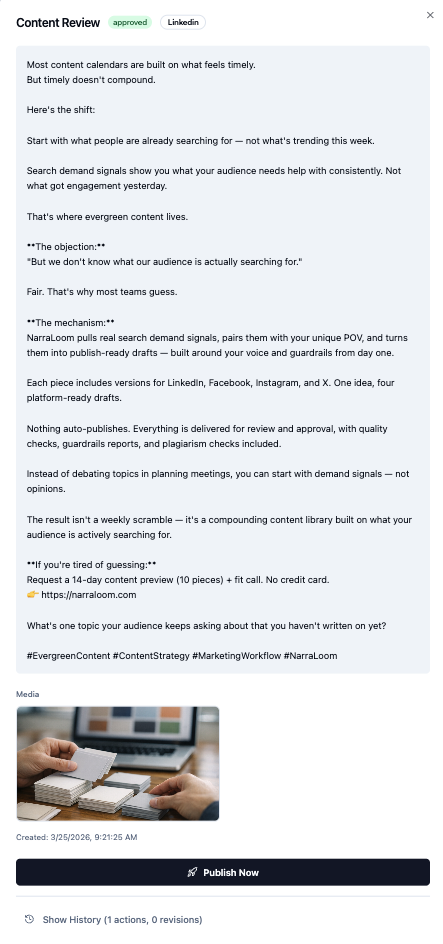
Full Dashboard View
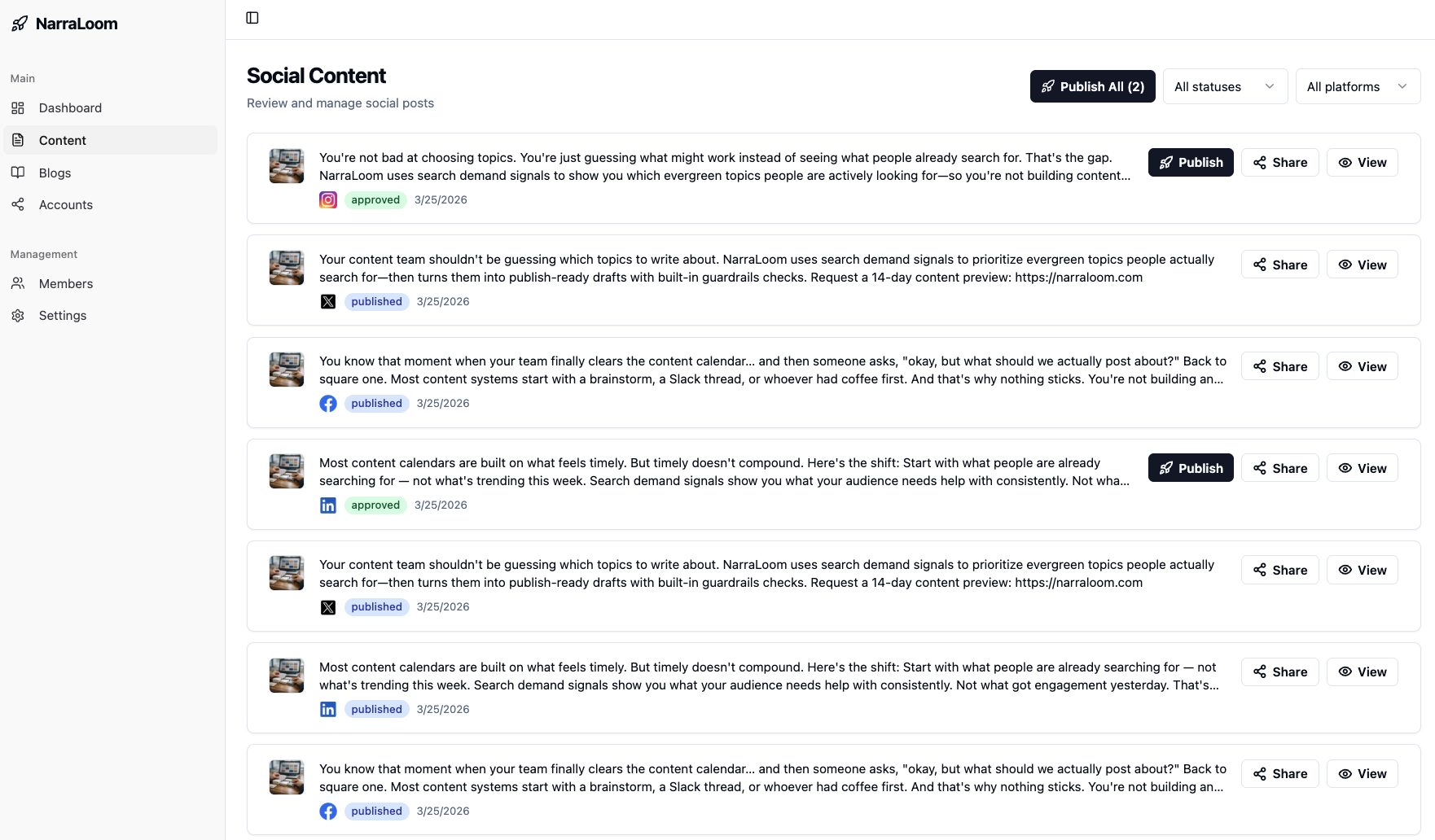
Manage, review, and publish across all platforms from a single dashboard.
Blog article — CMS-ready
Every content package includes a long-form blog article built from the same topic, optimized for search and ready to paste into your website.
AI Writing Tool vs. Content System — What's the Actual Difference?
AI Writing Tool vs Content System: The Real Difference | NarraLoom
Most teams adopt AI writing tools expecting a content breakthrough — faster drafts, more output, less effort. But speed alone doesn't solve the real problem. The bottleneck isn't generating words. It's deciding what to write, making it sound like you, getting it through approvals, and knowing it's safe to publish. This article breaks down the difference between using an AI tool as a faster typist and building a guided content production system that handles the entire workflow from topic selection to editorial review.
- Why faster drafts don't fix the content bottleneck
- What a guided content production system actually includes
- Voice alignment, guardrails, and approval packaging — built in, not bolted on
- How to evaluate whether you need a tool or a system
Built around search demand for "AI writing tool vs content system" with workflow-specific framing that positions NarraLoom's approach.
Package metadata
NarraLoom
AI writing tool vs content system
direct, specific, workflow-focused
no hype claims; no competitor disparagement; factual workflow descriptions only
Dashboard package
Customer CMS
Editorial team — after review
Blog posts are delivered separately to your dashboard. You review and publish on your schedule.
What shapes a NarraLoom deliverable
NarraLoom combines what people search for, your voice, and your rules to create weekly content that is easier to trust.
Topics people search for
Content starts with what your audience is already looking for.
Sounds like you
Every post reflects your voice, your tone, and what you want to emphasize.
Your rules, followed
Clear boundaries keep every post on-brand and safe.
Built for every week
NarraLoom is designed for ongoing content — not one-off bursts.
The goal is not just more content. The goal is recurring, on-brand output with more control.
What the 14-day preview includes
10 social posts over 14 weekdays
10 CMS-ready blog posts
Rules + plagiarism reporting
No credit card required
The preview is designed to let prospects experience how NarraLoom works, how review works, and what shows up before choosing a recurring plan.
What changes from one preview to another
Every real preview is shaped by the customer's brand, voice, topics, rules, and posting preferences. This sample shows a real published piece, but your preview will be configured around your own context.
Your voice
Your preview will sound like you — your tone, your positioning, your priorities.
Real topics
Topics based on what your audience searches for — not generic filler.
Your publishing choice
Social posts follow your preferred mode. Blog posts are delivered separately, ready for your website.
This sample shows real published output. Your preview reflects your own business context.
Sample package FAQ
See this with your voice and your topics.
Start a 14-day preview. You'll receive 10 content pieces like this — built from your positioning, checked against your rules, delivered for your review.
No credit card. 10 content pieces.